
Speed Limits Reduced as Part of Comprehensive Speed Management Plan
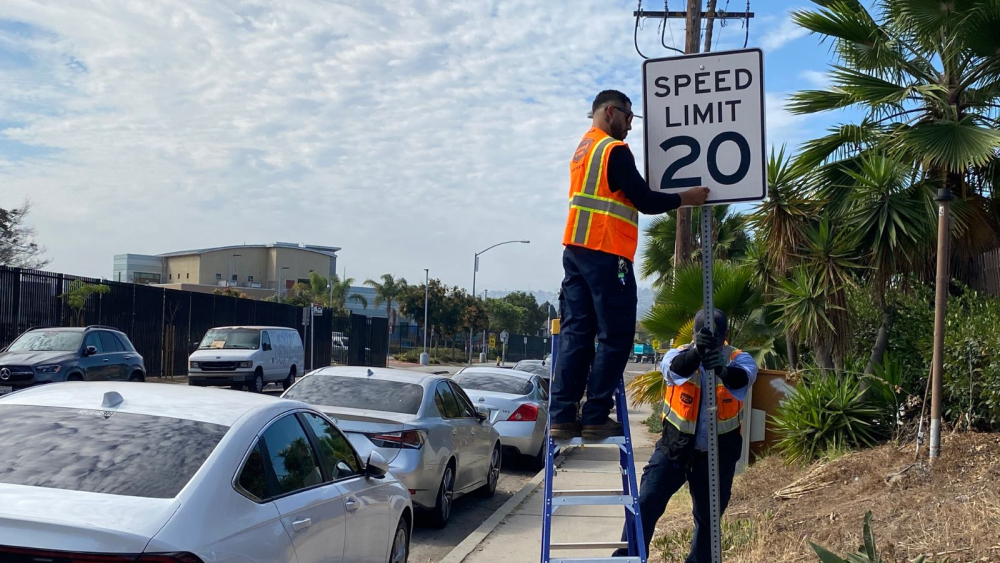
Mayor Todd Gloria joined Transportation Department officials today at Willow Elementary School in San Ysidro to announce the first speed limit reductions under the City of San Diego’s Comprehensive Speed Management Plan. This citywide, data-informed strategy will reduce vehicle speeds where allowed under state law and advance the City's Vision Zero commitment to eliminate traffic fatalities and serious injuries.
This week, the City began reducing speed limits in designated school zones in the communities of San Ysidro and Otay Mesa, with work continuing in neighborhoods across San Diego over the coming weeks.
"Every San Diegan deserves to get home safely, whether they're walking, biking, taking transit, or driving," said Mayor Todd Gloria. "Our first-ever Comprehensive Speed Management Plan is a smart, data-driven approach to improving traffic safety. Along with investments in safer street design and other improvements, this plan will help prevent crashes, save lives, and make it safer for everyone to travel through our neighborhoods."
On a daily basis in San Diego, people walk to school, bike to work, cross streets to reach transit, and drive to their destinations. While most trips end safely, traffic crashes remain a serious concern. Speed is one of the most significant factors in determining whether a crash results in a serious injury or fatality. On average, more than 180 traffic crashes in San Diego involve a fatality or serious injury each year, often occurring on streets with similar conditions and disproportionately affecting people walking and biking, older adults, and residents of historically underserved communities. For these reasons, reducing speeds — especially in places where people live, shop, attend school and access transit — is one of the most effective ways to save lives and prevent serious injuries.
In 2022, the U.S. Department of Transportation awarded the City of San Diego $680,000 through the Safe Streets and Roads for All (SS4A) grant program. The funding supports Vision Zero initiatives aimed at reducing fatal and serious injury crashes through safer street design, safer speeds, equitable access improvements and community engagement.
The SS4A grant funded a supplemental planning effort, including the development of this Comprehensive Speed Management Plan, which focuses specifically on identifying opportunities to reduce vehicle speeds across San Diego's street network where legally and technically feasible.
“Speeding continues to be one of the biggest contributors to crashes so we know slower speeds will save more lives,” said Interim Transportation Director Naomi Chavez. “By reducing speeds in school zones and highly trafficked corridors, we’re making our neighborhoods safer with every sign we install as part of this important project.”
In all, crews will be installing about 3,000 speed-limit reduction signs citywide. Sign installation will begin at the south end of the city and move northward until the project is completed in mid-2027.
San Diego maintains approximately 3,185 centerline miles of public streets, with about 842 miles included in the City's Engineering & Traffic Survey (E&TS) network. Under California law, speed limits above 25 mph generally require an E&TS and traditionally rely on the 85th percentile speed, meaning posted limits reflect how fast most drivers are already traveling.
While legally required, this method can make it challenging to proactively lower speeds on streets with higher safety risks, particularly in areas with significant pedestrian, bicycle, school, or commercial activity. Many residential streets outside the E&TS network default to a 25-mph speed limit under state law.
Recent changes in California law — including Assembly Bills 43, 1938 and 382 — now provide cities greater flexibility to reduce speed limits based on safety and street context, not solely on prevailing speeds. Together, these laws allow cities to reduce speed in specific situations:
· Safety Corridors: Up to 5 mph reductions on corridors with higher concentrations of fatal or serious injury crashes.
· High Pedestrian & Bicyclist Activity Corridors: Up to 5 mph reductions on streets near sidewalks, bikeways, transit and activity centers.
· Business Activity Districts: Reduced speeds to 25 mph or 20 mph on commercial streets with frequent crossings and parking activity.
· School Zones: Reduced speeds to 15 mph or 20 mph within 500 feet of schools, and 25 mph on nearby approach streets.
These provisions allow speed limits to better reflect how streets are used and who is present, particularly in areas where slower speeds are essential for safety. Using the new state guidelines, the City conducted a citywide, data-informed assessment to identify streets eligible for potential speed limit reductions.
The analysis found that more than 20% of San Diego's roadway network — or 679.1 centerline miles — is eligible for potential speed limit reductions.
The identification of these corridors reflects planning-level analysis only and does not represent a determination that any specific street is unsafe or that speed limit changes are automatically required.
The Comprehensive Speed Management Plan represents a significant step in aligning San Diego's speed limits with Vision Zero safety priorities. For the first time, the City has a clear and consistent framework to reduce speeds where they matter most.
Lower speed limits are one component of the City's broader Vision Zero strategy. However, lowering posted speed limits alone will not achieve Vision Zero. Speed management must be paired with continued investments in traffic calming, intersection safety, education and public outreach, and strategic enforcement.
Implementation of speed limit reductions has begun in eligible school zones in Council District 8. Additional speed limit changes identified in the Plan will continue to undergo required engineering review and field verification before being presented to the San Diego City Council for approval where necessary. The City will continue installing updated signs in phases while monitoring results and engaging the public to ensure speed reductions improve driver behavior and safety.
The City of San Diego’s Comprehensive Speed Management Plan can be found on the Vision Zero website.