
In-House Resurfacing Crews Pave Record Mileage in Single Year
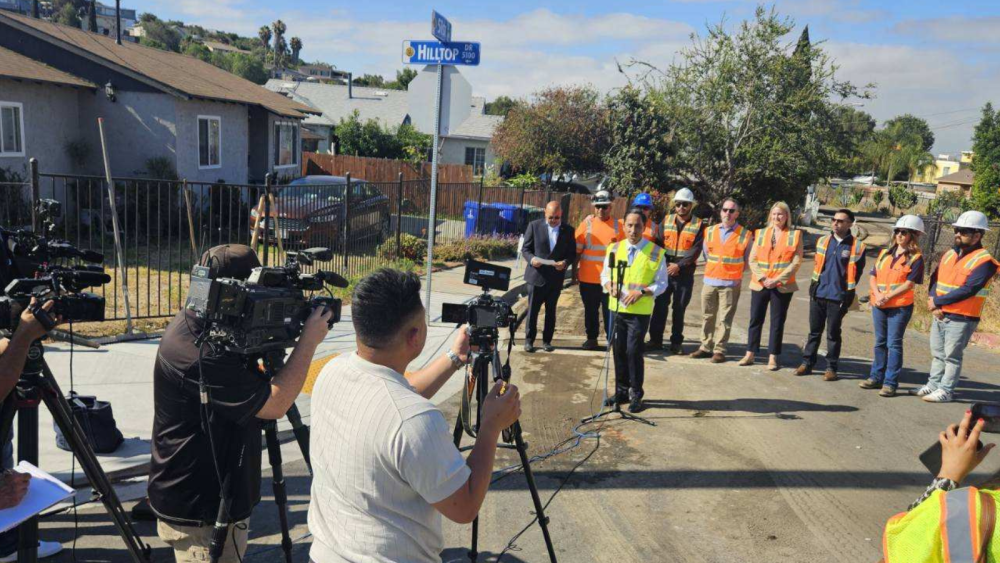
The City of San Diego has reached a major road resurfacing milestone as Transportation Department crews are on pace to complete 30 lane miles of street resurfacing this fiscal year, setting a new annual record for the City's in-house Mill-and-Pave Program.
Mayor Todd Gloria and Councilmember Henry L. Foster III joined City crews today on 51st Street in the Emerald Hills neighborhood, one of the City's most deteriorated road segments, which had a Pavement Condition Index (PCI) score of just 3.56 on a scale of 100 before rehabilitation, to mark the paving of the program's 30th lane mile of Fiscal Year 2026.
“Residents don't experience government through reports — they experience it through the condition of their streets, sidewalks, parks, and neighborhoods,” said Mayor Todd Gloria. “That's why fixing roads remains one of my top priorities. By investing in our in-house paving crews, we're able to repair some of San Diego's worst streets faster, stretch taxpayer dollars further, and deliver visible improvements in neighborhoods across our city. Reaching this record-setting milestone shows what sustained investment and a commitment to infrastructure can accomplish.”
The achievement marks the third consecutive year of growth for the City's in-house paving operation. Transportation Department crews completed approximately 20 lane miles of rehabilitation in Fiscal Year 2024 and 24 lane miles in Fiscal Year 2025. Reaching more than 30 lane miles this year represents a 25% increase over last year's production.
“The last pavement treatment on this stretch of 51st Street was 40 years ago, and it has been more than 50 years since the street received a full asphalt overlay,” said Councilmember Henry L. Foster III. “This is why I continue pushing for greater maintenance and investment in District 4 streets. This project is a meaningful and long-overdue accomplishment for the residents who rely on 51st Street every day. I am thankful to our hardworking crews for getting this work done, and I look forward to finding opportunities to grow the City’s in-house Mill-and-Pave capacity because this is how we lower costs and get more work done. We still have more work to do, and I will continue pushing for sustained, equitable investment in streets throughout District 4.”
The in-house Mill-and-Pave Program was established to complement contractor-delivered resurfacing projects and provide the City with greater flexibility to address streets in poor condition that might otherwise wait years for rehabilitation. The program focuses on smaller street segments and severely deteriorated surfaces that can be completed efficiently by City crews. The process involves curb-to-curb roadway rehabilitation by grinding away damaged asphalt and replacing it with new pavement. This asphalt overlay treatment restores road surfaces, improves ride quality, and makes streets safer to traverse.
The milestone supports the goals outlined in the City's Fiscal Year 2026 Pavement Management Plan, which established a target of rehabilitating 30 lane miles through in-house crews in addition to 115 lane miles of contractor-led rehabilitation and 225 lane miles of pavement maintenance citywide. Together, those efforts are expected to improve or preserve approximately 370 lane miles of streets this fiscal year.
"The expansion of our in-house paving capability is helping us stretch taxpayer dollars while accelerating improvements on streets that need attention the most," said Naomi Chavez, Interim Director of the City’s Transportation Department. "Our crews are focused on fixing roads in poor or failing condition, bringing smoother streets to neighborhoods across the city.”
San Diego maintains approximately 6,600 lane miles of streets and uses the Pavement Condition Index to evaluate roadway conditions and prioritize repairs.
The City's Pavement Management Plan uses a data-driven approach to identify and prioritize roadway investments, ensuring limited resources are directed where they can provide the greatest benefit to residents and the transportation network. The plan combines pavement condition assessments, traffic volumes, equity considerations and lifecycle cost analysis to guide decisions on maintenance and rehabilitation projects.
Residents can view current street conditions, planned paving projects and pavement improvement information at StreetsSD.sandiego.gov.