
Birds With Arms Helping Remind San Diegans To Recycle Their Food Scraps
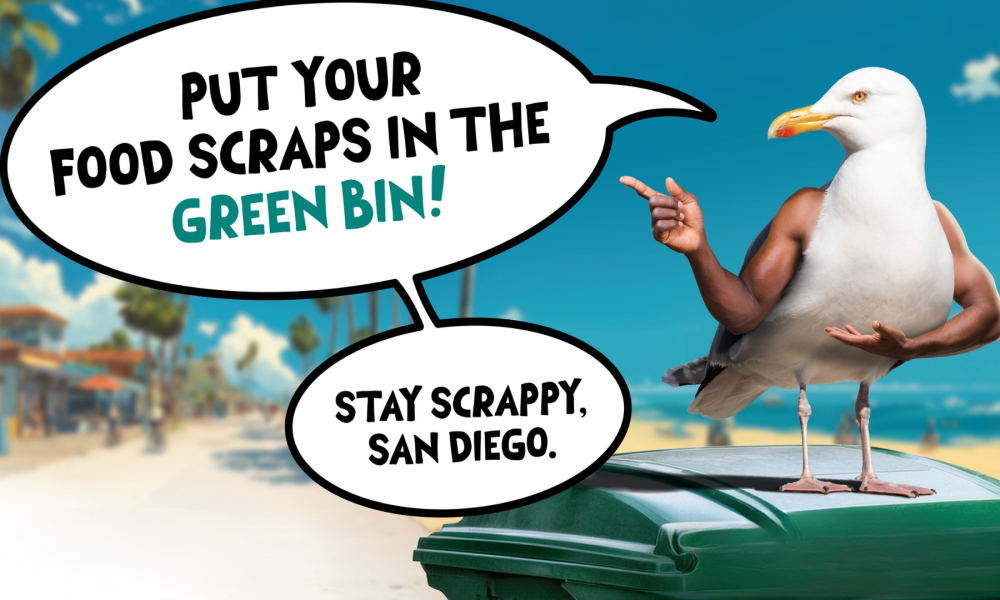
Some scrappy seagulls have a message for San Diegans when it comes to food waste. As part of the City of San Diego’s ongoing effort to encourage organic waste recycling, a new marketing and outreach campaign called “Stay Scrappy, San Diego!” features “Gary” and his fellow seagull friends, who use wit and wisdom to get a simple message across: food scraps belong in the green bin, not the landfill!
Funded through a state grant from CaRecycle, the educational campaign aims to increase awareness of the benefits of recycling organic waste and the “Stay Scrappy” flock is being heard in radio ads, and seen on billboards and social media.
“We are super excited about ‘Stay Scrappy’ and can’t wait to see how it reinvigorates organic waste recycling practices across San Diego,” said Julie Sands, Recycling Program Manager for the City’s Environmental Services Department. “We’re very grateful to CalRecycle for funding this project to inspire impactful behavior change through creative messaging and education. The goal is to increase participation and decrease contamination, and we hope that along the way people will get a chuckle or two.”
As San Diegans, we’re all too familiar with seagulls swooping in like scavengers and swiping hot dogs, churros and other food items right out of our hands. “Stay Scrappy” suggests that while seagulls do enjoy an occasional pizza crust or half-eaten bologna sandwich, maybe our avian friends are really just trying to help us recycle right by tossing food scraps into the green bin. When residents collect and recycle food scraps, it helps the City divert organic waste from the landfill and convert that organic waste into nutrient-rich compost.
The marketing agency responsible for “Stay Scrappy” is Most Likely To, a California company that has led successful creative efforts in San Francisco, Marin and other cities, earning multiple awards and effecting real change in recycling habits.
“Our biggest challenge was getting San Diegans’ attention around a topic—food recycling—that isn’t always on most people’s minds,” said Joseph Newfield, CEO of Most Likely To. “Humor is a powerful way to break through. If you can make someone laugh, you can usually get them to listen. ‘Stay Scrappy’ uses local personality to help San Diegans remember one simple message: food scraps go in the green bin.”
CalRecycle Local Assistance Grant funding supports education and emphasis on organic waste recycling as a part of Senate Bill 1383. In addition to the multilingual citywide marketing campaign, the City of San Diego’s grant work also includes door-to-door outreach for multifamily and commercial properties, edible food recovery efforts and promoting the use of compost and mulch.
When organic waste is recycled, it becomes a renewable resource creating compost to nourish our gardens, parks, farms and open spaces, and even producing renewable natural gas that could be used for cooking, powering engines and more. A hope of the campaign is to help residents understand that throwing things like plastic or glass into the green bin can contaminate the process and resulting product.
In the biggest change to waste management in San Diego since blue recycling bins were introduced in 1999, the City launched an Organic Waste Recycling Program in 2023. New green bins were rolled out to more than 200,000 households, empowering San Diegans to do their part for the environment by easily recycling food scraps, food-soiled paper and yard trimmings.
The program plays an important role in the City’s efforts to achieve Zero Waste by 2040 and make progress toward climate action goals. More than 267,507 tons of organic material have been diverted from the landfill in the last three years. According to the City’s Environmental Services team, participation in the organic waste recycling program has been impressive since the launch three years ago, but there’s room for improvement, and “Stay Scrappy, San Diego!” aims to do just that.